
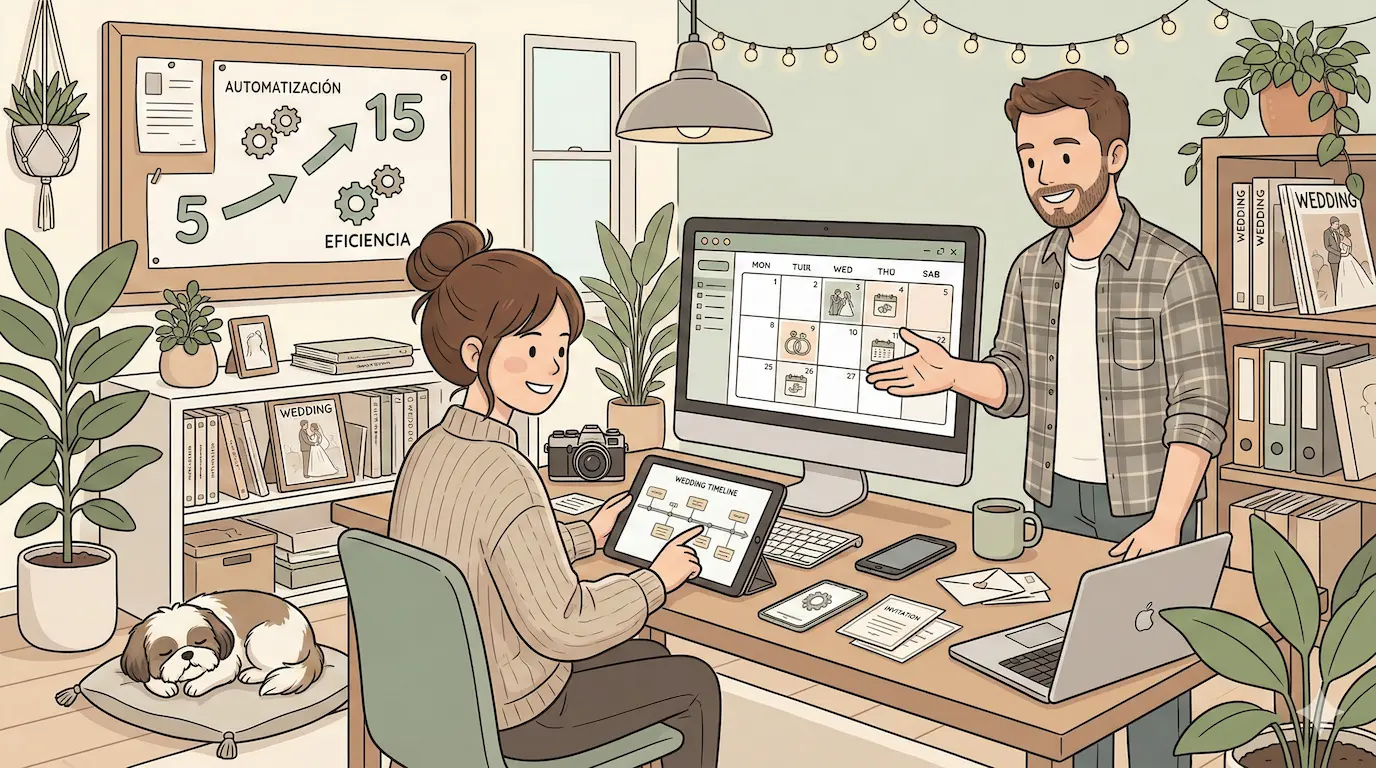
You started with one wedding. Then came referrals. Three weddings, then five. And now you are stuck on a familiar plateau: you want to grow, but every new wedding feels like another weight.
The problem is not your talent. The problem is that too much of your operation is still manual.
Planners who grow from 5 to 15 weddings do not work three times harder. They work with a better system.
The “I Can Handle Everything” Trap
At 5 weddings per year, manual workflows still feel manageable.
At 15 weddings, they collapse:
- 5 weddings x 150 guests = 750 interactions
- 15 weddings x 150 guests = 2,250 interactions
That is not a motivation issue. It is an architecture issue.
Step 1: Audit What Steals Your Time
Separate your work into two buckets.
High-value work (what clients truly pay for):
- Creative concept and experience design
- Vendor strategy and negotiation
- Day-of coordination and decision-making
- Client advisory and leadership
Operational work (necessary but low leverage):
- Sending one-by-one invitations
- Chasing pending confirmations
- Manual list updates
- Repetitive guest questions
- Last-minute count reconciliation
Most planners discover that 40%-60% of their time goes to low-leverage operations.
Step 2: Automate Guest Management First
Guest operations are usually the biggest time sink and easiest win.
Manual workflow (per wedding)
- Build and update spreadsheet
- Send personalized invites one by one
- Record responses manually
- Follow up manually
- Reconcile final counts manually
- Update every vendor manually
Typical time: 15-25 hours per wedding
Automated workflow
- Upload guest list
- Configure invitation message once
- Send personalized WhatsApp campaign
- Let confirmations update in real time
- Schedule automatic reminders
- Use live dashboard for decisions
Typical time: 2-3 hours per wedding
That can free 180-330 hours per year at 15 weddings.
Step 3: Standardize Without Losing Personalization
Scaling does not mean becoming generic.
Standardize:
- RSVP workflow
- Reminder sequence
- Core data collection
- Operational timelines
Personalize:
- Tone and style of invitations
- Couple-specific messaging
- Event-specific questions and details
With Confirmalia, each wedding can feel unique to the couple while your back-end process stays efficient and repeatable.
Step 4: Repackage Automation as Premium Value
Automation is not only a time-saving tool. It upgrades your positioning.
Compare:
- “I send invitations and follow up via WhatsApp.”
- “We include a professional guest management system with personalized WhatsApp invitations, one-click RSVPs, real-time dashboard access, automated reminders, and detailed reporting.”
The second offer sounds premium because it is structured, visible, and outcome-focused.
Step 5: Build a System, Not a Self-Managed Job
The real shift is mindset: from “I do everything” to “I design systems that deliver consistently.”
A scalable wedding business usually includes:
- Predictable lead generation
- Standardized onboarding
- Automated guest management
- Repeatable vendor coordination
- Excellence on event day
- Post-event feedback and referral engine
When workflows are systemized, delegation becomes possible without sacrificing quality.
A Practical 12-Month Roadmap
Months 1-2: Run one full wedding with automated guest management.
Months 3-4: Build master templates, reminder cadence, and offer packaging.
Months 5-8: Increase event load with confidence.
Months 9-12: Optimize metrics, delegate operations, and scale like a business owner.
You can keep surviving at 5 weddings with midnight admin and spreadsheet stress. Or you can build a system that supports 15 weddings with better margins and less chaos.
Automation does not replace your talent. It unlocks it.
Ready to scale without burning out? Try Confirmalia free and reclaim hours from your very next wedding.